EMG Tokenization Preserves Movement Information at a Fraction of the Bitrate
Raul C. Sîmpetru, Amin Olamazadeh, Devon Rohlf, Vlad Cnejevici and Alessandro Del Vecchio
Friedrich-Alexander-Universität Erlangen-Nürnberg
320 electrodes, one 20 ms update
Raw 16-bit EMG
209,715bits
Tokens
3,200bits
Hand-pose error, SPAR tokens versus continuous features
Learned tokens versus continuous features
Smaller stored payload than raw EMG
Channels tokenized within 20 ms on a Cortex-M55
Each electrode sends one 10-bit token every 20 ms.
Electrode 28 → 239 → 0011101111
Raw EMG exceeds this throughput above 42 electrodes; tokens fit up to 2,800. Payload only.
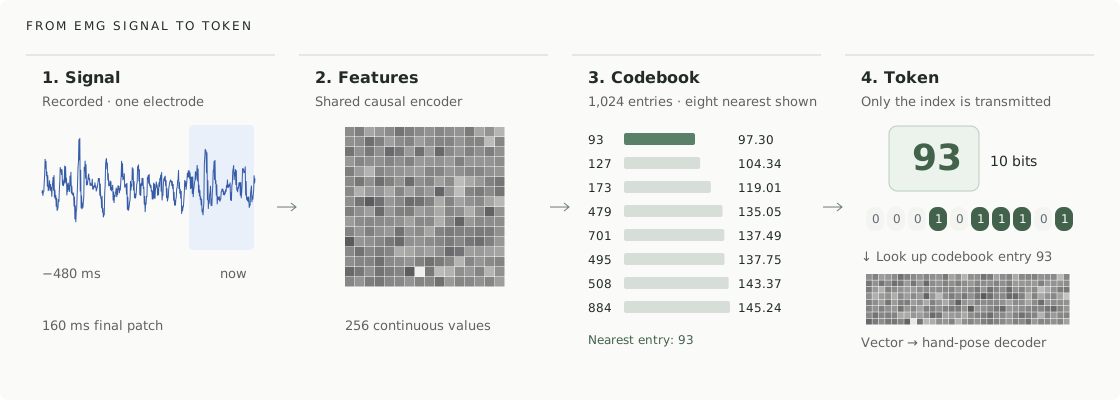
From EMG to tokens
Each electrode's recent EMG is replaced by the index of its nearest codebook entry.
Signal
One electrode · recorded
Features
Shared causal encoder
Codebook
1,024 entries
Token
10-bit index
→ Pose decoder
256 values → token 93 → 10 bits
Drag to exploreDetails +
01 / WINDOW
Start with a short history of muscle activity.
Compare the feature vectors +
Squared distance 97.2990
All 256 components · shared grayscale
View all component values
About this recorded example +
Each replay follows the same update. The numerical vectors, distances, and token IDs come from the recorded examples; the animation illustrates the processing order. Matching uses all feature dimensions and all 1,024 entries. The eight displayed candidates are ordered by distance. Grayscale uses a shared symmetric scale within each example.
One electrode and its neighbours
SPAR describes each electrode together with its right and lower neighbours.
Centre electrode
28
Row 4, column 4
c28h29v36a27
Token2390011101111
Decoded hand pose
Participant 6's fist, decoded from SPAR tokens and from continuous SPAR.
Tokenization is the smallest change
Electrode coverage, calibration and unseen recordings changed the error more than tokenization did.
Movement through token space
Participant 1's SPAR tokens, mapped with UMAP and coloured by movement.
Repetition phase
0%
All movements
19 repetitions
per movement.
About this view +
Each point is one of 14,861 updates from participant 1. SPAR token IDs are replaced with their codebook vectors across 320 electrodes. Lagged updates, sampled every 120 ms, supply the selected history. The animation follows phase-aligned mean trajectories through the saved embedding.
The three-dimensional UMAP is projected onto a separate mean-trajectory plane for each movement, and the groups are positioned separately. Each history setting has its own fitted view; changing history does not track points through a common coordinate system. The curves average 20 phase bins across complete repetitions and use a periodic spline to join their endpoints. The moving markers show normalized repetition phase, with playback slowed to eight seconds.
Open the figure ↗Video, light ↓Video, dark ↓History comparison ↓
Paper and materials
@misc{simpetru2026emgtokenization,
  title         = {EMG Tokenization Preserves Movement
                   Information at a Fraction of the Bitrate},
  author        = {Sîmpetru, Raul C. and Olamazadeh, Amin and
                   Rohlf, Devon and Cnejevici, Vlad and
                   Del Vecchio, Alessandro},
  year          = {2026},
  eprint        = {2610.32674},
  archivePrefix = {arXiv},
  primaryClass  = {eess.SP},
  doi           = {10.48550/arXiv.2610.32674}
}